Force Frames: Measuring What Matters
Strength is one thing. Measuring it accurately is another. Learn how force frame testing helps identify hidden deficits, track rehabilitation progress, and guide smarter return-to-sport decisions through objective data.

Sean Kelly, Strength and Conditioning Coach
When an athlete is recovering from an injury or trying to improve performance, one question always comes up:
How do we know they’re actually getting stronger?
For years, clinicians have relied on movement quality, exercise performance, and clinical observation to answer that question. Those tools still matter, but they only tell part of the story.
At Petroski Physio, we use force frame testing to add objective data to the equation. Instead of estimating strength, we can measure it. Instead of guessing whether an athlete is ready for the next phase of rehab, we can use real numbers to help guide those decisions.
What Is a Force Frame?
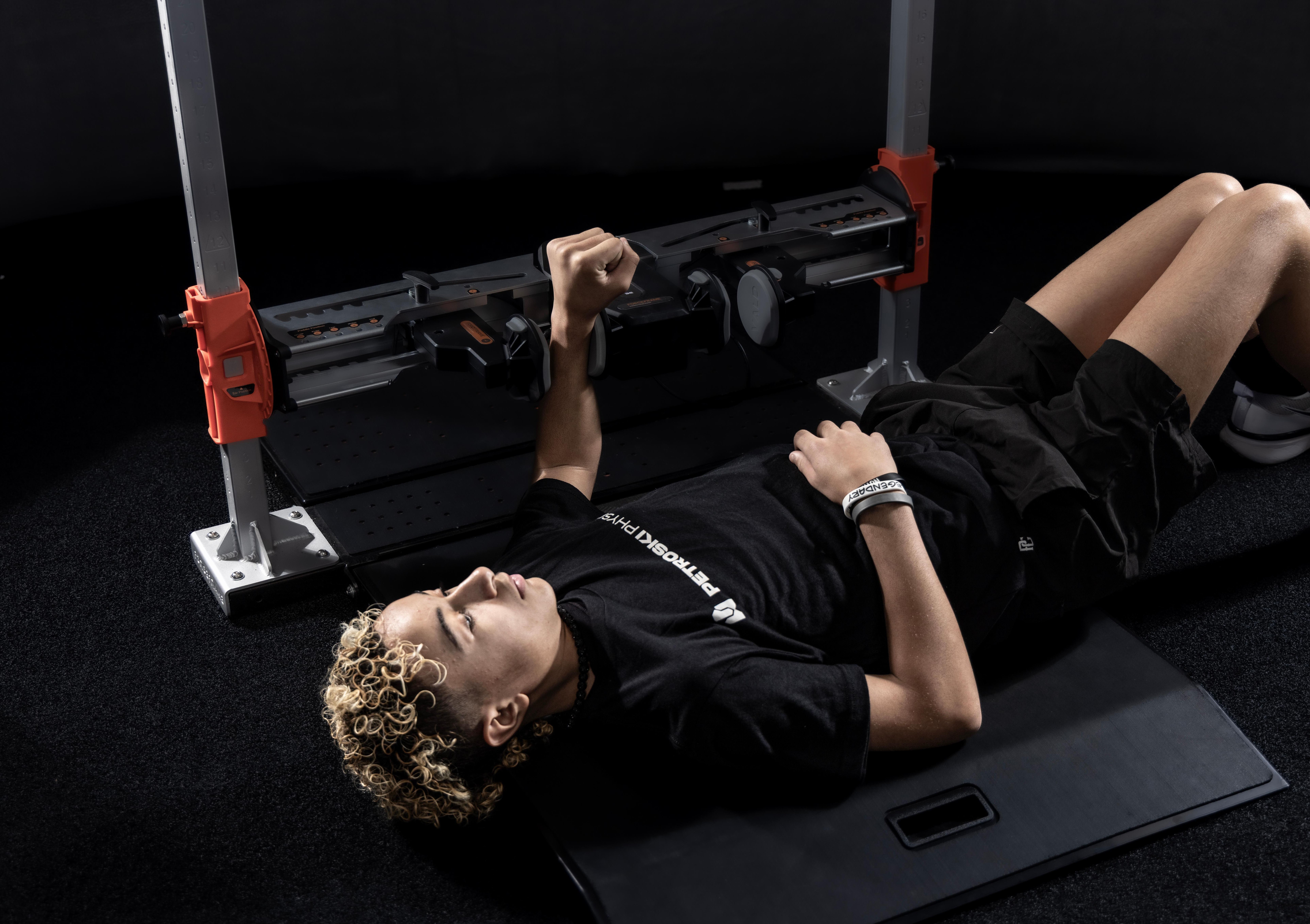
A force frame is a testing system that measures how much force an athlete can produce in a specific position.
During testing, the athlete pushes or pulls against an immovable resistance while sensors record the force being generated. Because there is no movement occurring, the test is considered isometric.
The process is simple, but the information it provides is incredibly valuable.
Force frame testing allows us to assess:
Maximum force production
Side-to-side strength differences
Strength relative to body weight
Progress throughout rehabilitation
Performance changes over time
Think of it as taking a snapshot of an athlete’s strength profile at a specific moment. It gives us a clearer picture of what the body is capable of doing beneath the surface.
Why Objective Testing Matters
Athletes are incredibly good at compensating.
Someone recovering from an ACL reconstruction may run well, squat comfortably, and even perform jumping drills without obvious issues. From the outside, everything can look normal.
But objective testing often tells a different story.
We’ve seen athletes who appear ready for the next stage of rehab but still demonstrate significant strength deficits compared to their uninvolved side. Without testing, those deficits can be easy to miss.
Force frame testing helps us identify those gaps before they become problems.
The goal isn’t to find reasons to hold athletes back. The goal is to make sure they have the physical capacity to handle the demands of their sport when they return.
More Than Just Knee Strength
One of the biggest advantages of force frame testing is its versatility.
We can evaluate multiple muscle groups throughout the body depending on the athlete, sport, and injury history.
Hip Strength
The hips play a major role in running, jumping, cutting, and landing mechanics.
Testing can help identify deficits in:
Hip abduction
Hip adduction
Hip flexion
Hip extension
Internal rotation
External rotation
These measurements can provide valuable information for athletes dealing with knee pain, hip pain, groin injuries, or recurring movement issues.
Knee Strength
For athletes recovering from ACL injuries, patellar instability, or other knee conditions, quadriceps and hamstring strength are often key pieces of the puzzle.
Force frame testing allows us to objectively monitor recovery and ensure strength is progressing appropriately throughout rehab.
Shoulder Strength
For overhead athletes such as baseball players, softball players, volleyball players, and swimmers, shoulder strength can have a major impact on both performance and injury risk.
Testing internal and external rotation strength can help identify imbalances that may influence throwing mechanics, shoulder health, and overall performance.
Finding Deficits Before They Become Problems
One of the most valuable aspects of force frame testing is its ability to identify weaknesses that aren’t obvious during everyday training.
An athlete may be performing well in practice while still demonstrating measurable deficits in key muscle groups.
For example, a soccer player may have excellent quadriceps and hamstring strength but show significant weakness through the lateral hip. Over time, that deficit could contribute to poor landing mechanics, decreased cutting efficiency, or increased stress on the knee.
By identifying these issues early, we can address them before they become bigger problems.
Tracking Progress With Confidence
One of the biggest benefits of objective testing is the ability to track meaningful progress over time.
Instead of saying, “Your leg looks stronger,” we can show exactly how much improvement has occurred.
That data helps athletes stay motivated, helps clinicians make informed decisions, and improves communication with physicians, coaches, athletic trainers, and parents.
More importantly, it gives everyone involved a clearer understanding of where the athlete stands in the recovery process.
Taking the Guesswork Out of Return to Sport
One of the most common mistakes in rehabilitation is relying too heavily on timelines.
Being six months removed from surgery doesn’t automatically mean an athlete is ready to return to competition.
Neither does being nine months out.
Recovery should be based on function, not just time.
Force frame testing provides objective benchmarks that help us determine whether an athlete has regained the strength necessary to tolerate the demands of their sport.
It’s one more piece of information that helps us make smarter decisions and build confidence during the return-to-sport process.
The Bottom Line
Force frame testing transforms strength from something we estimate into something we can measure.
It helps us identify weaknesses, monitor progress, guide rehabilitation, and make more informed return-to-sport decisions.
Most importantly, it gives athletes something they deserve throughout the rehab process: clarity.
Because when it comes to recovery and performance, better decisions start with better data.
Rehab, different.
Not a clinic. Not a gym.
A place built for progress.
A team built for performance.
A culture built for you.