Basketball Injury Rehabilitation: What Athletes Need to Rebuild Before Returning to the Court
Returning to basketball takes more than waiting for pain to disappear. Learn how strength, power, jumping ability, deceleration, conditioning, and objective performance testing help athletes safely return to the court after injury.
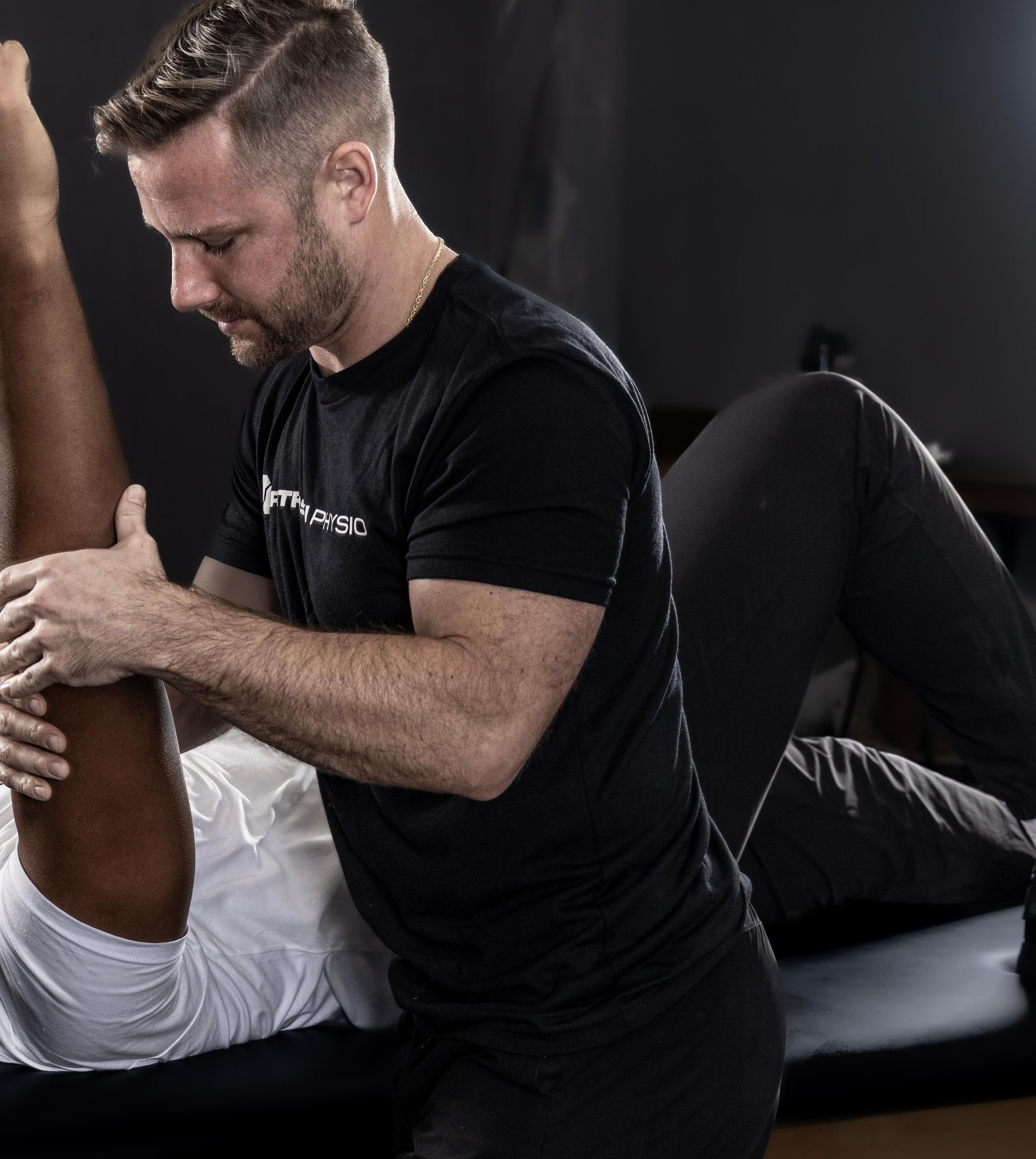
Nick Petroski DPT
What Is Basketball Rehabilitation?
Basketball rehabilitation is the process of restoring the strength, power, movement capacity, conditioning and confidence an athlete needs to return safely and effectively to basketball after an injury.
A complete basketball rehabilitation program should address more than the injured body part.
It should rebuild:
Lower-body strength
Quadriceps capacity
Calf, soleus and Achilles capacity
Jumping and landing ability
Acceleration and first-step power
Deceleration and braking ability
Change-of-direction performance
Basketball-specific conditioning
Confidence during unpredictable movement
Tolerance to full practices and games
The final goal is not simply to complete exercises in a physical therapy clinic, the goal is to become capable of playing basketball again.
Why Pain Alone Cannot Determine Whether You Are Ready
Pain matters, but pain is not a complete readiness test.
An athlete can have little or no pain while still having major strength, power or braking deficits.
This is especially common after:
ACL reconstruction
Patellar tendinopathy
Patellofemoral knee pain
Quadriceps tendon injuries
Ankle sprains
Achilles tendon injuries
Calf strains
Hip or groin injuries
Hamstring strains
Stress injuries
Extended time away from basketball
Your body is good at finding another way to complete a task.
You may jump high enough while unloading one leg. You may finish a sprint while avoiding full force through an injured ankle. You may complete a change-of-direction drill by using your hip or opposite leg to compensate for a weak quadriceps.
From the outside, the movement may look acceptable.
The underlying capacity may still be missing.
That is why objective basketball performance testing matters.
Basketball Players Need to Be Able to Stop, Not Just Jump
Most young basketball players want to improve how high they jump, how fast they sprint or how explosive their first step looks.
Those qualities matter.
But one of the most important abilities in basketball is the ability to stop. Every time you close out, reject a screen, attack a gap, perform a pull-up, plant into a crossover or recover defensively, your body has to control momentum.
Acceleration creates speed and Deceleration allows you to use it.
If you cannot absorb force quickly, your body may take longer to stop, use inefficient movement strategies or shift stress toward the knee, ankle, Achilles tendon or opposite leg.
This is why an athlete can look fast in straight-line running but still struggle when basketball becomes reactive.
Real basketball rehabilitation must rebuild your brakes.
The Most Important Physical Qualities for Basketball Athletes
There are hundreds of exercises, testing metrics and recovery tools available. That does not mean every option deserves equal attention.
The best basketball rehabilitation programs prioritize the physical qualities that create the greatest impact.
For most basketball players, those priorities include:
General strength
Quadriceps and anterior knee capacity
Calf, soleus and Achilles capacity
Power and rapid force production
Deceleration and change-of-direction ability
Basketball-specific conditioning
Progressive exposure to real basketball
These are the foundational qualities.
Recovery boots, massage, cupping and other treatments may help an athlete feel better, but they cannot replace missing strength, tissue capacity, conditioning or court exposure.
General Strength Is the Foundation
Your body has to tolerate force before it can express force quickly.
A basketball player who lacks general strength may still be skilled, fast and athletic, but the athlete has less physical reserve when practices become intense, games accumulate or fatigue increases.
Can you produce high levels of force?Tolerate meaningful load? Control your body through the positions basketball requires? Can you perform the work consistently without a major increase in pain or swelling?
For athletes between the ages of 12 and 26, strength training should be coached, progressed and matched to training experience. Younger athletes do not need reckless maximal lifting. They need excellent technique, progressive loading and consistent exposure to age-appropriate resistance training.
Quadriceps Strength Is Essential for Basketball Knee Health
The quadriceps are critical for sprinting, jumping, landing, stopping and changing direction.
They are especially important when the knee is bent and your body has to control forward momentum.
When quadriceps capacity is limited, athletes may:
Avoid deeper knee positions
Land stiffly
Take longer to stop
Shift load to the opposite leg
Use excessive hip or trunk movement
Lose force during takeoff
Experience recurring anterior knee symptoms
Struggle with confidence during cuts and landings
This is common after ACL reconstruction, patellar tendon pain and prolonged knee irritation.
A player may believe the knee is fully recovered because it no longer hurts during basic activity. Objective testing may show that the injured leg is still meaningfully weaker.
That is a problem.
Basketball does not ask your knee to work only when you are rested and prepared. It asks the knee to produce and absorb force at high speed, under contact and while fatigued.
How We Test Quadriceps Strength
Quadriceps strength can be measured with isokinetic testing, handheld or fixed dynamometry, and other objective strength-testing systems.
Testing at multiple knee angles can help identify where force production is limited.
One particularly important position is around 60 degrees of knee flexion, because this range is highly relevant to force production during stopping, planting and changing direction.
We are not only looking at whether one leg is stronger than the other.
We also want to know:
How much force can each leg produce?
Is the athlete strong enough relative to body size?
Does force drop at a specific knee angle?
Is the athlete protecting a painful range?
Has strength returned to the athlete’s previous baseline?
Is the “good” leg actually strong enough to be used as the standard?
A left-to-right comparison is useful, but symmetry alone can be misleading.
Two weak legs can look symmetrical.
The goal is not simply to make the injured leg match the other leg. The goal is to restore both legs to the level required for basketball.
Calf, Soleus and Achilles Strength Matter More Than Most Players Realize
Basketball places enormous demands on the lower leg.
Your calf complex and Achilles tendon contribute to:
Repeated jumping
Sprint acceleration
First-step quickness
Rebounding
Cutting
Defensive movement
Stopping
Elastic force production
Repeated contacts with the floor
The soleus, a powerful calf muscle that works heavily when the knee is bent, is especially important for basketball. A basic standing calf raise does not fully tell us whether your lower leg is prepared for the sport.
We need to know how much force the athlete can produce in basketball-relevant positions and whether the Achilles tendon can tolerate heavy and repeated loading.
An athlete with inadequate soleus or Achilles capacity may still be able to run and jump, but struggle when jump volume, practice duration or game intensity increases.
That often creates a cycle:
The athlete feels better during basic rehabilitation.
Court activity increases quickly.
The tendon or calf becomes reactive.
Training is reduced again.
The athlete never develops enough long-term capacity.
The answer is usually not complete rest.
The answer is properly dosed loading.
Building Achilles Tendon and Soleus Capacity
Heavy tendon loading should be progressed based on symptoms, strength and next-day response.
A useful program does not only ask, “How did it feel during the exercise?”
It also asks:
How did the tendon feel later that day?
Was morning stiffness worse the next day?
Did swelling or soreness increase?
Can the athlete repeat the exposure?
Is force capacity improving?
Is the athlete tolerating more basketball activity over time?
The goal is to create a tendon that can repeatedly handle basketball, not a tendon that only feels good after treatment.
Jump Height Does Not Tell the Entire Story
Jump testing is common in basketball for an obvious reason: basketball players jump.
But only measuring jump height gives an incomplete picture.
Two athletes can reach the same jump height using very different strategies.
One athlete may produce force quickly, absorb load efficiently and transition rapidly from lowering to takeoff.
Another may need more time, use excessive depth, shift away from one leg or rely on com
pensations.
Force plates allow clinicians and performance coaches to examine how the athlete creates the jump, not just the final height.For basketball athletes, the ability to absorb force quickly and transfer that force into takeoff may be more informative than jump height alone.
What Is Eccentric Deceleration?
Eccentric deceleration describes your ability to absorb and control force while your muscles are lengthening.
In basketball, that occurs when you:
Land from a rebound
Stop after a drive
Lower before jumping
Close out on a shooter
Plant before changing direction
Control your body after contact
If your eccentric deceleration capacity is limited, you may take longer to stop or rely on a different movement strategy. A player may still jump to the same height, but the force-plate data may show that the body is taking longer to produce the movement or is absorbing force less effectively. That information can help identify fatigue, incomplete rehabilitation or a need for more targeted braking work.
Early Force Production Drives Basketball Explosiveness
Basketball actions happen quickly.
You usually do not have several seconds to create force. You need to create meaningful force almost immediately.
That is why early concentric impulse matters.
Early concentric impulse reflects how much force an athlete produces during the first portion of the upward phase of a jump or explosive action.
This is important for:
First-step acceleration
Quick rebounds
Rapid second jumps
Shot blocking
Closeout reactions
Short-space changes of direction
Exploding out of a defensive stance
An athlete may be strong but slow to express that strength.
Another athlete may be fast but lack enough total force. Those athletes should not receive identical training programs. Testing helps identify the actual limitation.
Strength and Power Are Not the Same
Strength is your ability to produce force.
Power is your ability to produce force quickly.
Basketball requires both.
A stronger athlete has a larger force reserve. A powerful athlete can use that force within the limited time available during the sport.
Rehabilitation should usually rebuild them in a logical sequence:
Restore tissue tolerance.
Restore basic strength.
Build force through relevant joint positions.
Increase the speed of force production.
Add jumping, landing and sprinting.
Add deceleration and change of direction.
Add reactive basketball tasks.
Build full practice and game tolerance.
Trying to skip directly to explosive training without restoring the underlying capacity is usually a mistake.
The task may look more athletic, but the missing physical limitation remains.
Why Deceleration Testing Is Critical
A basketball player should not be cleared only because they can squat, jump or run in a straight line.They also need to prove that they can approach at speed, stop hard, change direction and accelerate away.
Movement Problem May Actually Be a Strength Problem
A movement strategy may be the athlete’s solution to a missing physical capacity.For example, an athlete who cannot control momentum with the recovering leg may shift force toward the opposite leg during a change of direction. The opposite knee may then collapse inward or appear to demonstrate poor mechanics. The obvious reaction is to coach the visible knee position. But the actual limitation may be inadequate braking strength in the other leg.This matters because practicing the same task repeatedly without restoring the missing capacity may only teach the athlete to compensate more efficiently. Before blaming coordination, ask whether the athlete is physically capable of completing the task.
Basketball Rehabilitation Must Progress From Capacity to Skill
Rehabilitation should not begin and end with basketball drills.
A basketball drill is not automatically a rehabilitation exercise just because it involves a ball.
The progression should move from controlled capacity toward unpredictable sport demands.
Stage 1: Restore Basic Capacity
This stage may include:
Pain-management strategies
Range-of-motion restoration
Isometrics
Foundational strength work
Early conditioning
Basic balance and control
Progressive tendon loading
Stage 2: Build Strength and Force
This stage may include:
Heavy resistance training
Single-leg strength
Quadriceps loading
Calf and soleus loading
Hamstring and hip strengthening
Isometric testing
Controlled landing work
Stage 3: Develop Power
This stage may include:
Countermovement jumps
Loaded jumps
Low-level plyometrics
Medicine-ball work
Sprint starts
Olympic-lift derivatives
Fast-intent isometrics
Stage 4: Restore Deceleration and Change of Direction
This stage may include:
Braking drills
Planned cuts
45-degree and 90-degree cuts
180-degree turns
505 testing
Defensive stops
Closeout progressions
Higher-speed entry into cuts
Stage 5: Add Reactive Basketball Movement
This stage may include:
Unplanned changes of direction
Defender-based reactions
Ball-handling under pressure
Live closeouts
Evasion drills
Transition actions
Contact preparation
Small-sided games
Stage 6: Restore Practice and Game Tolerance
This stage may include:
Individual basketball workouts
Controlled team drills
Non-contact practice
Contact practice
Full practice
Repeated full practices
Restricted game minutes
Full competition
You do not earn the next phase because enough time has passed.
You earn it by demonstrating the required capacity.
Conditioning Is Part of Injury Rehabilitation
A player who is strong when rested but loses control under fatigue is not fully prepared.
Fatigue changes how athletes:
Produce force
Absorb force
Make decisions
Position their bodies
React to opponents
Repeat high-intensity actions
Tolerate tendon and joint loading
Basketball conditioning should prepare an athlete for repeated efforts, not just steady-state running.
Depending on the athlete and stage of rehabilitation, conditioning may include:
Low-intensity aerobic work
Bike or pool conditioning
Tempo running
Court intervals
Repeated accelerations
Repeated change-of-direction work
Basketball skill conditioning
Small-sided games
Practice-based loading
The final conditioning test is not whether you can survive one hard workout.
It is whether you can repeatedly practice and play without a major drop in movement quality, performance or symptom response.
Previous Injury Is One of the Most Important Risk Factors
The athlete’s injury history matters.
A prior injury may leave behind:
Strength deficits
Reduced tissue capacity
Loss of muscle size
Reduced power
Fear or hesitation
Conditioning deficits
Changes in movement strategy
Incomplete exposure to basketball demands
This does not mean reinjury is inevitable.
It means the rehabilitation process has to restore what was lost.
One of the biggest mistakes in return-to-sport rehabilitation is assuming that time automatically restores capacity.
It does not.
If the athlete does not progressively train strength, power, braking, conditioning and basketball exposure, those qualities may remain below their previous level.
Why Baseline Testing Matters for Basketball Players
The best time to collect performance data is before an injury happens.
Preseason or offseason testing creates an individual profile that can later guide training and rehabilitation.
Useful basketball baseline tests may include:
Countermovement jump
Single-leg jump
Isometric mid-thigh pull
Quadriceps strength
Hamstring strength
Hip and groin strength
Calf and soleus strength
Ankle range of motion
505 change-of-direction testing
Sprint testing
Conditioning assessments
Normative data from other basketball players can be helpful, but your own previous performance is often the more meaningful target.
A 17-year-old high school guard should not be evaluated exactly like a 25-year-old professional center.
Position, age, training history, body size, injury history and level of competition all matter.
The goal is to understand what is normal and effective for the individual athlete.
What Basketball Players Should Be Tested After an Injury
The testing battery should be specific to the injury and the athlete, but a complete return-to-basketball evaluation often includes several categories.
Strength Testing
This may include:
Quadriceps strength
Hamstring strength
Calf and soleus strength
Hip abductor and adductor strength
Single-leg strength capacity
Force relative to body weight
Left-to-right comparison
Jump Testing
This may include:
Countermovement jump
Single-leg jump
Repeated jumps
Drop jump
Landing assessment
Force distribution
Early impulse
Braking characteristics
Speed and Change-of-Direction Testing
This may include:
Acceleration
Planned cutting
505 test
Defensive shuffle to sprint
Closeout to recovery
Reactive cutting
Deceleration from progressively higher speeds
Conditioning Testing
This may include:
Repeat sprint ability
Repeat jump ability
Court intervals
Basketball-specific work capacity
Performance decline across repeated efforts
Heart-rate recovery
Session and next-day symptom response
Basketball Exposure
This may include:
Individual skill sessions
Controlled team drills
Non-contact practice
Contact practice
Full practice
Repeated practice days
Game-minute progression
No single test can prove that an athlete is ready.
Readiness comes from the complete picture.
Common Basketball Rehabilitation Mistakes
Returning Based Only on Time
Six months, nine months or twelve months tells us how long it has been since an injury.
It does not tell us whether strength, power, conditioning and sport tolerance have returned.
Stopping Rehabilitation When Pain Decreases
Pain reduction is an early milestone, not the end of the process.
Using Only Basic Hop Tests
Hop distance can be useful, but athletes can compensate and still reach an acceptable number.
Ignoring the Calf and Soleus
The lower leg is essential for repeated jumping, sprinting and cutting.
Avoiding Heavy Strength Training
Basketball itself is high force. Rehabilitation has to prepare the body for that reality.
Performing Agility Drills Without Testing Braking Capacity
Fast-looking drills do not guarantee that the athlete can safely absorb momentum.
Repeating the Task Without Fixing the Limitation
More cutting will not automatically fix inadequate quadriceps strength.
More jumping will not automatically fix poor tendon capacity.
Treating Recovery Tools as the Main Intervention
Recovery treatments may support training. They cannot replace training.
Returning to Games Before Tolerating Full Practice
Competition should not be the athlete’s first exposure to full basketball intensity.
How Do You Know When You Are Ready to Return to Basketball?
A complete decision should consider:
Pain and symptom response
Swelling
Range of motion
Strength
Force relative to body weight
Side-to-side differences
Jump strategy
Power
Braking ability
Change-of-direction performance
Conditioning
Confidence
Full-practice tolerance
Response the following day
For many athletes, useful goals may include restoring the injured side close to the uninjured side and returning key performance measures to preinjury levels.
But there is no universal number that guarantees safety.
Testing should guide the decision, not replace clinical reasoning.
For athletes under 18, return-to-sport decisions should also involve the parent or guardian, medical provider, rehabilitation professional and appropriate coaching or athletic-training staff.
What Parents of Youth Basketball Players Should Understand
Parents often hear that an athlete has been “cleared.”
That word can mean different things.
A physician may clear the healing structure medically. That does not always mean the athlete has completed performance rehabilitation.
Parents should ask:
Has strength been measured objectively?
Has jumping been assessed?
Has the athlete restored braking and change-of-direction ability?
Has conditioning returned?
Has the athlete completed full practices?
How did the body respond the next day?
Is there a written return-to-play progression?
What physical qualities are still below target?
Who is communicating with the coach?
The goal is not to keep an athlete out longer than necessary.
The goal is to avoid sending the athlete back underprepared.
What Basketball Injury Prevention Should Actually Look Like
No program can prevent every injury.
Basketball is fast, physical and unpredictable.
But athletes can improve their ability to tolerate its demands.
An effective basketball injury-reduction program should include:
Progressive strength training
Quadriceps development
Hamstring strength
Calf and soleus loading
Jump and landing exposure
Deceleration training
Change-of-direction practice
Basketball-specific conditioning
Gradual workload progression
Adequate sleep and nutrition
Monitoring of pain, soreness and fatigue
The exact warm-up or exercise selection is less important than consistently developing these capacities.
Do not chase a perfect movement screen while ignoring strength, conditioning and workload.
The Bottom Line for Basketball Athletes
You do not return to basketball because you can run.
You do not return because you completed a few jump drills.
You do not return because the pain is gone.
You return when your body has rebuilt the capacity to handle basketball.
That means you can:
Produce force
Absorb force
Stop hard
Change direction
Jump repeatedly
Accelerate again
Perform while tired
Tolerate full practice
Recover and repeat it
Whether you are 12 years old, playing high school basketball, competing in college or pursuing a professional career, the standard should remain the same:
Rehabilitation should prepare you for the game you are returning to.
Do not train only to pass a basic test.
Train to play.
Rehab, different.
Not a clinic. Not a gym.
A place built for progress.
A team built for performance.
A culture built for you.